Review: Happy Hallowee Dancing Skeleton for Craft Fairs
As an embroidery designer who has spent countless weekends standing behind booths at local craft fairs and farmers markets, I have learned that not every digital file translates into a bestseller. The gap between a cute digital embroidery file on your computer screen and a tangible handmade product that stops a customer in their tracks is bridged by careful selection and testing. This season, I am putting the Happy Hallowee Dancing Skeleton under the microscope to see if it has what it takes to drive sales for small shop owners and Etsy sellers alike.
First Impressions: Mood and Market Fit
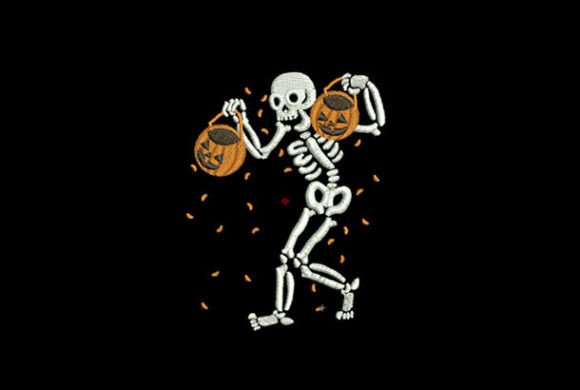
The title itself, Happy Hallowee Dancing Skeleton, suggests a playful, whimsical vibe rather than something dark or terrifying. In the world of seasonal decor, this is a crucial distinction. Modern buyers often lean toward "spooky cute" or farmhouse-style Halloween decor that can stay up from October through November without feeling too grim. Based on the description, this design aims to decorate clothes or home items, positioning it as a versatile asset for any Halloween embroidery project.
When I visualize this skeleton dancing, I imagine a design that brings energy to static fabric. For a craft fair booth, energy sells. A static image might be overlooked, but a character in motion draws the eye. If the stitch work captures that movement with fluid lines and balanced proportions, this design could become a staple for buyers looking for festive yet approachable decor. It feels less like a horror movie prop and more like a friendly neighbor waving hello, which broadens its appeal to families and younger demographics.
Product Applications: Where This Design Shines
The versatility of a machine embroidery design is determined by how well it adapts to different substrates. Here is how I see the Happy Hallowee Dancing Skeleton performing across various popular craft fair items:
- Tote Bags and Market Bags: This is arguably the strongest application. A large-scale version of the skeleton on a natural canvas tote creates an instant statement piece. As a tote bag design, it offers high visibility. Customers love functional art, and a dancing skeleton adds personality to grocery runs or trick-or-treating hauls.
- Apron Embroidery: Kitchen textiles are huge during the fall baking season. Placing the skeleton on the bib of a sturdy cotton apron makes for a charming gift item. The apron embroidery market is competitive, so a unique, animated character helps differentiate your small shop product from generic leaf or pumpkin motifs.
- Tea Towel Embroidery: For a more subtle approach, scaling down the design for tea towel embroidery works well. However, one must be cautious with fabric texture. Waffle-weave or thick terry cloth can distort fine details. I recommend testing on smooth linen or flat-weave cotton to ensure the dancing limbs remain distinct.
- Embroidered Patches: Patches are low-commitment impulse buys. An embroidered patch featuring this skeleton allows customers to add Halloween flair to existing jackets or bags. This requires precise digitizing to ensure the edges are clean and the satin stitches hold together without fraying.
Production Practicality and Batch Selling
For those of us running a business, time is money. A design that looks great but takes three hours to stitch is not viable for a high-volume craft fair weekend. The description notes that the file comes in multiple formats, which is essential for compatibility with various machines. However, before committing to batch production, you must evaluate the stitch density.
If the Happy Hallowee Dancing Skeleton relies heavily on dense fill stitches to create solid bones, it may pull on lighter fabrics or take too long to complete. Ideally, the design should use a mix of satin stitches for outlines and lighter fills for larger areas. This balance ensures the finished product remains flexible and soft, rather than stiff and cardboard-like. For caps and curved surfaces, lower density is critical to prevent puckering.
Photography is another key factor. Does the design photograph well for your online listings? High-contrast thread colors against neutral backgrounds usually perform best in printable mockup scenarios and real-life photos. A white skeleton on black fabric pops, but ensure the contrast is sharp enough to be seen in thumbnail images on Etsy or Instagram.
Critical Technical Considerations
While the concept is strong, execution is everything. Here are the specific technical hurdles you need to address before listing this as a craft fair product:
- Hoop Size Constraints: The description does not specify exact dimensions. You must check the hoop size requirements. If the skeleton is designed for a 5x7 hoop, it may be too large for standard cap frames or small pouches. Always verify the maximum dimensions to avoid resizing errors that distort the aspect ratio.
- Stabilizer Selection: Dancing implies movement, which often means thinner lines. To prevent these lines from breaking or sinking into the fabric, use the right stabilizer. Cut-away stabilizer is generally safer for wearable items like tote bags and aprons, while tear-away might suffice for decorative pillows that won't undergo heavy washing.
- Detail Clarity: Tiny details can get lost. If the skeleton has facial features or small bone segments, test stitch them on scrap fabric first. On textured towels or dark fabrics, small elements can disappear. If the design loses clarity at smaller sizes, reserve it for larger items like pillow covers or wall hangings.
- Commercial Licensing: The description states it "can be use," which is grammatically incomplete but implies usability. However, never assume. Always confirm the license terms for commercial embroidery. Ensure you are allowed to sell finished physical goods made with this embroidery file. Protecting your business from copyright issues is non-negotiable.
Boosting Visual Appeal and Brand Consistency
Incorporating the Happy Hallowee Dancing Skeleton into your lineup can significantly enhance your booth's visual appeal. It adds a narrative element—customers can imagine the skeleton dancing at a party, which sparks conversation. Engagement drives sales. When a customer asks, "Is he dancing?" you have opened the door to discuss the quality of your work and the uniqueness of your design assets.
To maximize impact, consider creating a cohesive collection. Pair the skeleton with complementary fonts or simpler geometric shapes to create bundle deals. For example, offer a personalized tote bag with the skeleton and the customer's name. This adds perceived value and justifies a higher price point. Ensure that the thread colors you choose align with your overall brand aesthetic. If your brand is rustic, stick to earthy tones and creams. If it is modern and bold, use high-contrast neons or classic black and white.
Final Verdict for the Season
The Happy Hallowee Dancing Skeleton has strong potential as a seller for the upcoming season, provided it is executed with technical precision. It fits the current trend of playful, non-scary Halloween decor that appeals to a broad audience. By focusing on high-visibility products like tote bags and aprons, and by rigorously testing stitch density and fabric compatibility, you can turn this digital file into a profitable physical product.
Remember to create at least one real mockup before launching. See how it looks in natural light, how it feels to the touch, and how it holds up after a wash. These small steps separate amateur hobbyists from professional Etsy sellers and boutique makers. With the right preparation, this dancing skeleton could very well be the star of your holiday display.